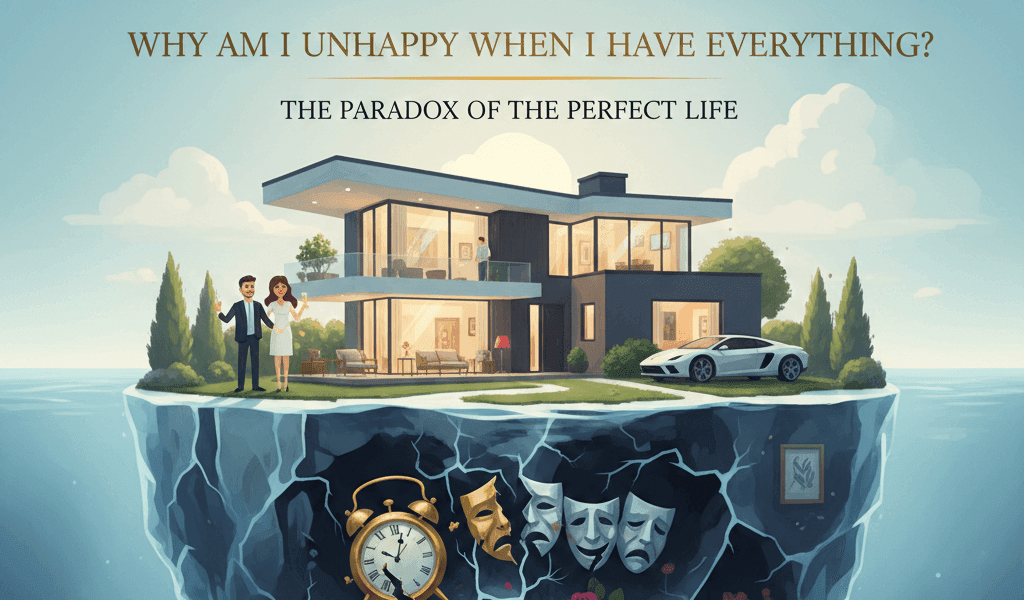
In my late twenties, I looked at a mental checklist I had spent years meticulously filling out. The right education? Check. The promising career? Check. The good partner, the house, the social circle? Check, check, and check.
I honestly thought that feeling great was a destination I would reach if I just followed the blueprint. I believed that once I arrived there, I would surely be happy. Instead,, there was no “there” there, and I felt unhappy regardless. Sounds familiar?
If you are asking yourself, “Why am I so unhappy when I have a good life?”, I want you to know two things: first, you are not strange or broken; you are just human and in very good company. Second, there is a reason for the unhappiness—it may be hidden from your view right now, but it’s there.
The Shame of Feeling Unhappy for No Reason
When we reach a point where we think we have everything, we are also acutely aware of our privilege. We know that many people are struggling for basic survival, fighting sickness, or living in oppressive situations. So we carry a heavy layer of shame on top of our unhappiness. We ask ourselves: “What is wrong with me? I have a good life, I should be happy.”
But the hard truth is that no achievement, success, or privilege can create happiness in the long run. I know, it goes against everything we’ve been taught. It’s a tough pill to swallow. On the plus side, once we truly understand this, we can let go of shame and look for answers in the right places.
The Treadmill of “More”: Why Success Often Feels Like Moving in Place
Research shows that there is a psychological mechanism at play when external circumstances fail to make us happy. It’s known as Hedonic Adaptation.
The core idea, popularized by a famous 70’s study on lottery winners and accident victims, is that we have a built-in, personal level of happiness (our baseline), and that external events have no lasting impact on this level. When something wonderful happens—say, we win a few million in the lottery—we feel very happy initially, but within a year or so, we return more or less to our baseline. The same goes for difficult events, like ending up in a wheelchair. This concept has been nuanced in further studies, but by and large, the mechanism of hedonic adaptation has been validated.
When we feel unhappy even if we have everything, it might just be that we have reached the limit of what external things can provide. We have returned to our baseline. So, if we were unhappy before building our “great life,” we will tend to be unhappy after. This is exactly what happened to me.
It does not mean we can’t change our level of happiness; it means we should stop expecting so much from external circumstances. If something makes us unhappy despite a good life, the cause is internal (which sounds like a mission statement for shrinks, and maybe it is…).
Beyond the Labels
We can find loads of excellently AI-generated posts informing us that the explanation for our unhappiness is “depression” or “dysthymia.”
There is certainly a sense of relief in having a name for our distress, and there is real value in mental health professionals having a common language for a cluster of symptoms.
However, a label explains absolutely nothing. The same goes for the “it’s just your brain” assertion. Of course it’s in our brain—where else would it be, our foot? The work of understanding the cause still needs to be done. While I cannot guess your unique story from a blog post, I can give you hints to help you start your investigation.
First things first : Who Decided What a “Good Life” Looks Like?
More often than we realize, when we can’t find our way on a map, the problem isn’t our sense of direction—it’s the map itself. In this case the map is our initial vision of “a good life”, that we dutifully followed. But who drew the map?
Let’s take a bit of time to think about how we decided what the “right” things to put in our life were. Did you become a doctor because you had an inner drive to help and a great curiosity about the human body, or because it meant being successful and making your family proud? Did you get married because you found a deep connection, or because everyone around you was doing it? The difference here is between intrinsic and extrinsic motivation:
- Intrinsic Motivation: This is the internal drive to do something because it is inherently satisfying, interesting, or meaningful to us. This is the stuff we like doing even if no one is watching.
- Extrinsic Motivation: This is when we do something to obtain a reward or avoid disapproval. In our adult lives, this often manifests as seeking social approval, status, a specific salary, or meeting the expectations of our environment (parents, friends, partners, bosses, society).
It all sounds a bit theoretical, but felt from the inside, it makes a hell of a difference. Relying on extrinsic motivation isn’t bad, and it’s certainly not unusual —it’s a survival strategy. The need to belong is a very powerful drive indeed for all of us, as Baumeister and Leary famously demonstrated. Often, “having it all” simply means having a list of things prescribed by our culture. It can have very little to do with what we really want.
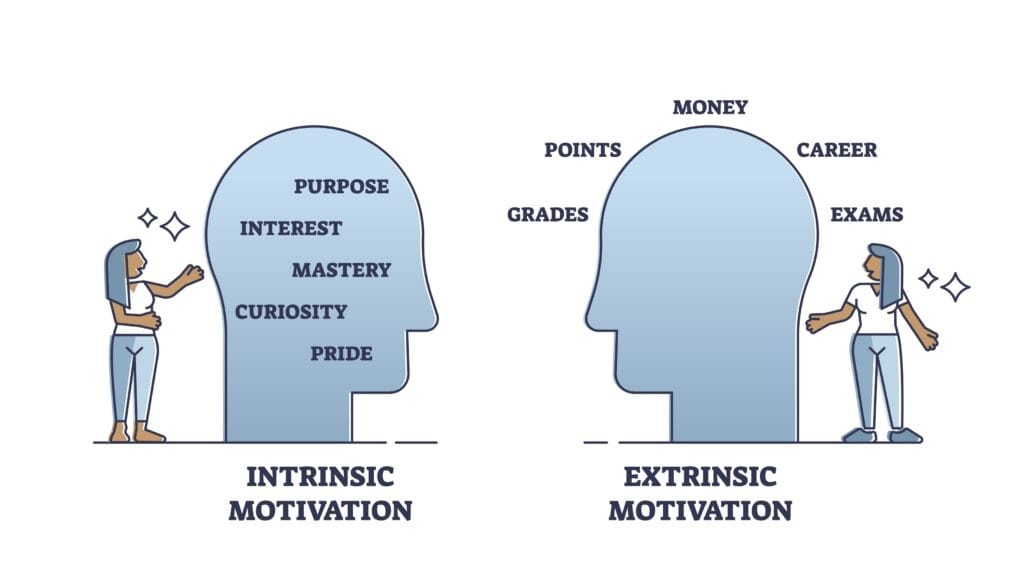
On the other hand, intrinsic motivation is the real wind in our sails. As I learned becoming a psychotherapist, intrinsic motivation makes work feel so rewarding it almost feels like not working. After years of banking (which I chose mostly for extrinsic reasons, and as a result felt like army crawling), it truly amazed me. It still does.
And yes, I understand that we can’t always do exactly what we want. But does it mean we cannot do anything we want? Of course not. If our life is a collection of pieces approved by our environment but none that truly suit us, we aren’t living a full life. We are just a passenger in an expensive car, getting very little satisfaction.
Were You Taught How to Get Your Needs Met?
Some parents make sure their children’s needs are filled as best as possible, encouraging them to express their emotions and teaching them how to get their needs met while respecting others (mainly by example). This is called very good parenting, and unfortunately, very few of us had access to that level of parenting mastery.
However, with “good enough” parenting, we ended up being able or organize our lives according to a mix of what was possible and what we truly desired. The big decisions were powered by our own wind, and we are today in a relatively good spot.
But we can still lose sight of what we need in smaller, daily choices, especially if we are in a position of caring for others. After a while, it can bring us down, even if we have a “good life” that we truly chosen.
Take my friend Chris, who always knew she wanted children. She loved being pregnant, loved babies, and felt truly on purpose as a mother. The reality of caring for babies without much help, though, deprived her of basic needs: sleeping, seeing her friends, exercising, and having some sort of intellectual stimulation. She ended up feeling unhappy within a situation she truly desired (and as a result, feeling immensely guilty, of course).
The key for her was to see her need for time away from mothering as legitimate. I have experienced both mothering full-time and being a working mother, and I can tell you with experiential certainty: baby mothering is far more exhausting than investment banking. Why then should it be the only job without rest?
Sometimes, getting help is not possible for us at all. I acknowledge that; but in that case, please let’s not pretend we have a great life: if our basic needs are not met, it’s normal to feel (temporary) unhappy. Often though, we can hire paid or unpaid help so that we can rest.
That’s what Chris did : she hired help in the form of her children’s father and her mother to pursue fulfilling activities a few hours a week, and she felt instantly better.
If you are in a caring situation, in your personal or professional life, beware: it’s very easy to put our needs on the back burner and forget about them. Some of us have an automated attitude of fulfilling everybody’s needs before attending to our own. It is culturally stronly encouraged (especially for women), but it’s also nonsense: if we do this, ou turn never comes, and we may end up in a very resentful, unhappy place. That’s because a life without any consideration for our own personal needs, and no access to ressources, is in fact not “a good life”.
Self-Alienation: When You Lose Access to Your Inner World
That’s all well and good, you might say. I am fully committed to doing whatever I really want with my life and take care of my needs. The only problem is that I have no idea what they are.
Yes, I know the feeling. When we have lost access to our needs, our desires, and our emotions (in other words self-alienation), we often end up feeling empty of positive emotions — or suffering from anhedonia . It is indeed very difficult to get our needs met if we don’t know what they are.
When we are feeling empty, ou needs, desires and emotions still exist: we just have lost access to them. This disconnection is a learned behavior : in order to be accepted and survive in an environment where our true feelings were seen as inconveniences—or worse, as reasons for shame—we had to bury the whole lot deep inside. We buried them so well that we eventually lost sight of them ourselves. Then, we have no way of steering our lives in a fulfilling direction; we are just going through the motions and doing what is expected because, you know, we must move in some direction.
One way of understanding this internal disconnect is through the Internal Family Systems (IFS) model, developed by Dr. Richard Schwartz. In this view, our psyche is not a single mind, but a system of “parts.”, for example:
- Managers: These are the highly functional, proactive parts of us that run our daily life. They are responsible for our checklist—the career, social etiquette, and perfectionism. Their job is to keep us safe and accepted. They are the ones who built our perfect lives, and frankly, we owe them a lot.
- Exiles: These are the younger, more vulnerable parts of us that carry the burdens of past wounds—feelings of being unlovable, “not enough,” or neglected. Crucially, these parts also hold our profound needs and our capacity for joy.
Manager parts spend an enormous amount of energy keeping Exiles away from our consciousness because they fear that if our vulnerability or true needs were seen:
- we would either drown in our pain and being unable to function and participate in life,
- or we would be rejected by others because our Exiles carry shameful and distateful emotions, needs and wants.
When we feel unhappy despite having everything, it is often because of this dynamic. We are high-functioning thanks to our Managers, but we are not whole since our Exiles are missing from our experience. The happiness we should feel is being blocked by the walls built to keep our pain at bay.
Life can then seem externally great, and internally empty and cold; this situation can lead us to use obsessions with people as a way out. That’s the bad news. The good news is that our needs, desires, and emotions have not disappeared—they are still there within us, and we can find a way to access them if we consciously chose to look inside and discover who we really are.
Relevant Posts
- Why Am I Obsessed with Someone?: Understand how the void in your life might be driving you toward romantic obsession as an escape.
- How to Stop People Pleasing: Learn how to stop building your life for others and start listening to your own needs.
Scientific Resources
- On Hedonic Adaptation: Brickman, P., Coates, D., & Janoff-Bulman, R. (1978). Lottery winners and accident victims: Is happiness relative? Journal of Personality and Social Psychology.
- On Motivation: Ryan, R. M., & Deci, E. L. (2000). Self-determination theory and the facilitation of intrinsic motivation, social development, and well-being. American Psychologist on the website of the Self Determination Theory.
- On the Need to Belong: Baumeister, R. F., & Leary, M. R. (1995). The need to belong: Desire for interpersonal attachments as a fundamental human motivation.
- On Internal Family Systems therapy: Buys, M. E. (2025). Exploring the evidence for Internal Family Systems therapy: a scoping review of current research, gaps, and future directions. Clinical Psychologist, 29(3), 241–260.
Books & Resources
- Internal Family Systems: No Bad Parts by Dr. Richard Schwartz.
- Finding ourPath: The Way of Integrity and Finding Your Own North Star by Martha Beck, and Who you were meant to be by Dr Lindsay Gibson
- Perfectionism and Depression: Perfectly Hidden Depression by Dr. Margaret Rutherford.
- How we lost sight of ourselves : Children of emotionnally immature parents, by Dr; Lindsay Gibson.


Pingback: Why am I Obsessed with Someone I Barely Know? - Pick a shrink’s brain
Pingback: Lindsay Gibson’s “Adult Children of Emotionally Immature Parents”: A Comprehensive Review - Pick a shrink’s brain