
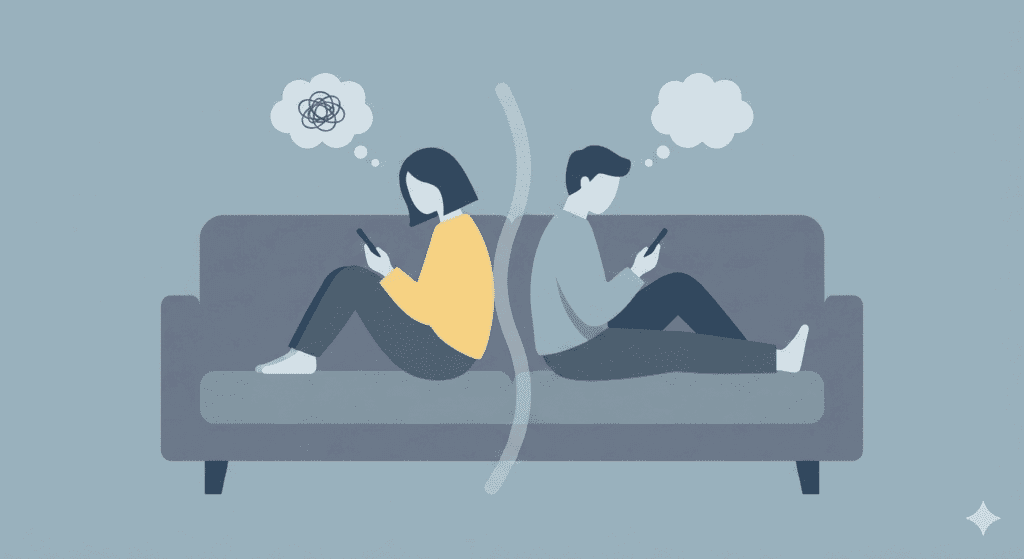
We are socialized to believe loneliness is a “lack of person” problem. To be fair, the message is not entirely wrong: if our lives are devoid of people, we do have a loneliness problem. We are social animals, as the saying goes.
But to view relationships as a total protection against loneliness is misleading. Even if the story tells us that if we find “The One,” loneliness will disappear forever, for some of us the “voilà” moment never comes. Or worse, it comes, lingers for a while, and then evaporates. We are left sitting on a sofa next to a person we love—or at least a person we live with—feeling, well, lonely.
How is this possible? What went wrong?
If this is where you are right now, let me start by saying two things. First, what you are feeling is very common, even if nobody at the dinner party is talking about it. Second, there is nothing broken about you. Loneliness is not a sign that you, or even your relationship, are a failure; it’s a signal from a part of you trying to tell you something important.
So let’s have a look at what your loneliness may be telling you.
Are we really talking about a relationship ?
This might sound like a ridiculous question, but bear with me.
The other day, a very dear friend of mine came to see me, clearly in pain over relationship difficulties. I listened as he described his crushing feelings of abandonment. About ten minutes in, I had a gnawing doubt. “How many times have you actually met this person in the real world?” I asked.
The answer: Once. In a café.
The rest of the relationship was a digital construction—social media messages, late-night DMs, and the interpretation of emojis. In his mind (and heart), he was in a relationship. On her side, I suspect she was just checking out the possibility of a relationship (which is, you know, fine).
Of course, it’s so obvious from the outside when we have no emotional stake. We can feel all judgmental and superior—until we are the ones trying to conjure up a relationship out of thin air. This type of delusion didn’t wait for social media to exist, but technology certainly makes it easier. It’s effortless to drop a heart emoji or a “thinking of you” message without being truly “in,” and it’s very tempting to believe these are signs of commitment to a relationship when we really, really want it.
In fact, our collective hunger for real connection is so deep—and so universal—that it has become one of the most exploited vulnerabilities in the modern world. Every year, billions of dollars are lost to sophisticated digital scams that promise exactly what we are starving for: to be seen, to be ‘special,’ and leave the dreaded territory of loneliness.
A real relationship requires at least three things: Explicit Mutuality (you’ve both said “we are doing this”), Consistency over Time (it survives a boring Tuesday and a flat tire in the rain), and Integrated Presence (you know their friends, their tastes, and how they tend to react when irritated).
This doesn’t mean that connecting digitally is doomed to failure. It means digital connection is a tool to initiate or facilitate a relationship, but a lot of stuff needs to happen above and beyond to get to a real relationship.
In other words, if you feel lonely because you are trying to get emotional connection from a digital fantasy, your loneliness is a reality check a part of you is sending your way.
Relationships and the Fear of Intimacy
Let’s move to the other end of the spectrum: we are in a committed, long-term relationship. We’ve had plenty of boring Tuesdays and we know exactly how they react when irritated. And still, the loneliness is here.
Sometimes, we are living with a partner who does everything we expect—except the emotional connection we expect. They pay the bills, fetch the kids, never miss a birthday, and are generally well-tempered and kind, but they seem to show no interest in our inner experience.
When we try to share how our day went, or deeper still, our hopes, fears, or painful memories, we get the wandering eyes, the distracted look, or an absence of questions. Sometimes they downright change the topic (“Where the hell are the car keys?”) or simply leave the room. It may take a while to spot this, especially if there was some emotional connection at the beginning that slowly faded away. But once we realize it’s happening, we can’t help feeling locked out. This relationship seems stuck to the surface of things, lacking emotional depth and substance.
It can be that our partner really has no interest at all. Truly immature people, such as narcissists or psychopaths, do not even perceive others as real; they view everybody as a means to obtain what they need (narcissistic gratification, money, status, respectability, whatever). But frankly, if we live with such a person, feeling lonely is probably the least of our worries; staying sane is challenging enough.
More often, the lack of connection is about their fear—the fear of the depth and intensity of human emotions, the fear of intimacy.
During an extended family dinner once, an elderly woman shared the story of losing her only pregnancy. I reached out and said, “I’m so sorry, that must have been incredibly painful,” hoping to give her space to be seen in her grief. Later, another family member explained I shouldn’t have done that: by acknowledging the pain, I was supposedly pushing the poor woman more deeply into it. This person seriously thought it’s better not to talk about painful events, otherwise we risk wallowing or drowning in them. Better to behave as if they had not happened.
If your partner grew up in a family like that, they may truly believe that sharing deep, emotional stuff is dangerous. When you try to get close, they don’t see an invitation to be intimate; they see a threat to their stability (and possibly yours). They aren’t malicious; they are scared. They may love you very much, even if that doesn’t make your side of the bed any less cold.
The Legacy of the Emotionally Immature Parent
Can we maybe go back in time, and try to assess if we felt this loneliness within your family even as a child? If you have felt utterly alone in your childhood already, I have to give you a very clear message : your loneliness as a child had nothing to do with who you were and what you did. It was the result of parental failure to connect. I know this may be quite a shock to hear, when we have spent years assuming it was all our fault. But it is true, it’s very true.
In her brilliant work, Lindsay Gibson talks about the “Adult Children of Emotionally Immature Parents.” She points out that constant emotional loneliness often stems from not being “seen” by the people who were supposed to love and protect us early in our lives. It’s a very nice way of saying they were not interested in what was happening inside us.
If our parents met our basic needs (food, bed, education) but were self-preoccupied or emotionally shallow, we learned a problematic lesson: My internal world is not interesting to others. What I need is not important. We often translate this into “I’m not enough as I am.” If they actively shamed our emotions, we may have learned that showing who we are invites aggression. We become so busy hiding who we really are, what we really feel or want, that over the years we lose sight of ourselves.
As adults, we carry this into our relationships. We aren’t convinced we have a right to have emotional needs. We don’t believe anyone would want to be with us just for who we are. So we spend our lives hiding, pretending we don’t need anything, not showing our real emotions and desires. In other words, we have built a wall to protect ourselves. And this wall prevents intimacy.
Shame and Unshakable Loneliness
This brings us to the internal barrier: Shame.
As you may already know, shame is different from guilt. Guilt is: “I did something bad,” which comes with the possibility of an apology. Shame is: “I am bad, and I must hide it.” It feels like there is no way to fix shame apart from becoming someone else — I realise this may sound ridiculous, but I remember that it is precisely what I wanted as an adolescent. I know now that I was far from alone.
When we carry deep-seated shame, we are convinced that if people truly saw our “real” selves—the messy, scared, self absorbed, “inappropriate” parts—they would scream in horror and run for their lives. So, we put up a persona and behave according to what we think people expect from us. (Truth be told, we often don’t even know what we really want anymore anyway.)
I spent my early adult years in this relational prison. I know what it’s like to not want to be seen and to not believe someone can really love me. Even if a partner is obviously loving, a part of us whispers: “They don’t love me. They love the character I’m playing. If they knew the real me, they’d be gone.” If we are hiding behind a mask of shame, no amount of external love can reach us. We need to address our shame first.
Killing Intimacy by turning our partner into a “Project”
As children, when our emotional needs aren’t met, we don’t just give up. We adapt by telling ourselves a story. We imagine that, someday, we will find a person who will finally make everything right. We think, “If I can just find someone who truly loves me, I will finally be happy and whole.” This is what Lindsay Gibson calls a “healing fantasy.” I don’t know about you, but I clearly remember having already these healing fantasies as a child.
We carry this fantasy into our adult relationships like a hidden script. We aren’t just looking for a partner; we are looking for someone to fix our internal pain. Richard Schwartz, in You Are the One You Are Looking For describes this as turning our partner into a “Redeemer.” Instead of seeing the human being in front of us—with their own flaws and unique needs—we see someone who can heal and repair us.
According to Schwartz, when the fantasy starts to crumble (and it always does, usually because it’s very apparent the other person is not here to repair us), we usually fall into one of three protective stances, or “projects”:
- We try to fix them: We embark on a mission to change them. We nag, manipulate, or lecture them, trying to convince them they shouldn’t be the way they are. They should be like what we think would heal us. (Spoiler: our partner will not cooperate; nobody wants to be intimate with someone trying to control them).
- We try to fix ourselves: If we are “good” at shame, we think, “If I’m perfect enough, they’ll finally give me that connection.” We try to morph into what we think they want, which actually prevents connection because the real us has checked out.
- We hide: We realize the fantasy is dead, so we check out emotionally. We stop sharing anything real to avoid more disappointment. Retreating like this ends intimacy—and can start an exhausting pursuer – avoidant dance.
We do this because we don’t know what else to do. But I believe, like Richard Schwartz, that we need to do a U-Turn: we need to get intimate with ourselves instead of focusing solely on the relationship.
The Hard Truth: It’s Usually “Both/And”
This section took me years to understand, and it might be the hardest to hear.
All of these explanations are not exclusive. You can have an emotionally distant partner and be carrying deep shame as a result of a lonely childhood. In fact, we often unconsciously choose people who cannot relate to us intimately because, on some level, we are scared of intimacy ourselves.
If I choose a partner who shuts down when I talk about feelings, I get to stay hidden and safe. I get to complain about being lonely, but I don’t ever have to face the anxiety of being truly seen, or my fear of being abandoned or controlled. The truth is, we cannot have a relationship with someone else that is better than the one we have with ourselves. Hence the necessary U-Turn.
A Note of Hope
If you’ve read this far and you feel hopeless, I want you to take a breath.
Mapping the territory is the first step to freedom. When we are able to truly realize something, it’s usually because we are ready to grow in that area (Plus, taking a deep breath is almost always a good thing!).
You are the one you have been waiting for. No partner, no matter how perfect, can bridge the gap between you and your own soul. But as you start to look at these parts of yourself with curiosity instead of judgment, you create a space where you can finally come home to yourself—and then, eventually, meet others.
We’ll talk more in future posts about how to actually do that “U-Turn” and start the healing process. For today, just notice: Which of these “possibilities” feels like it was written specifically for you?
Relevant Posts
Scientific Resources
- On the fear of Intimacy: Descutner, C. J., & Thelen, M. H. (1991). Development and validation of a Fear-of-Intimacy Scale. Psychological Assessment. This paper suggest that the fear of intimacy isn’t about “not liking people” but is actually a high level of anxiety about being truly seen.
- On the impact of a difficult childhood on relationships: Dorahy, M. J., et al. (2013). Complex trauma and intimate relationships: The impact of shame, guilt and dissociation. Journal of Affective Disorders.
Books & Resources
- The Internal Family Systems’ take on relationships: You Are the One You’ve Been Waiting For: Bringing Inner Systemic Therapy to Intimate Relationships by Richard C. Schwartz.
- How our early experiences can lead us to feel lonely in relationships : Children of emotionnally immature parents, by Dr; Lindsay Gibson.


Pingback: Why Your Boundaries Aren’t Working (And Why He Forgets Your “Talks”) - Pick a shrink’s brain