
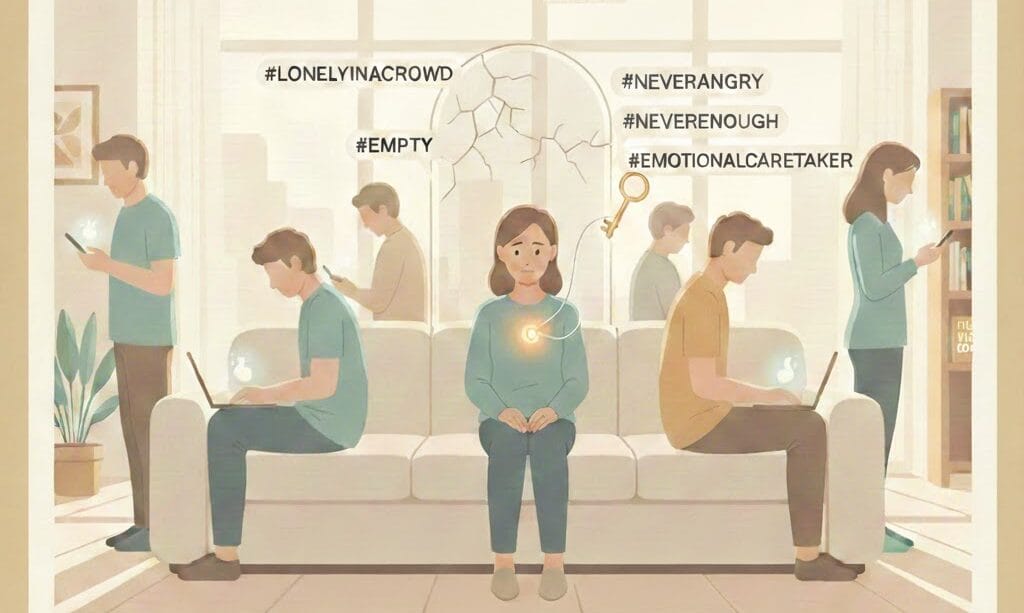
It’s really puzzling when we are unhappy, but we cannot understand why. From the outside, our life seems fine, but internally, we are not. We feel a persistent loneliness, even when surrounded by good people. We also feel empty, lacking a clear sense of our own emotions or desires. Without these internal navigational clues, we do things simply because we feel we have to—because it is expected of us. Life begins to feel mechanical and low in satisfaction.
If this sounds familiar, and these feelings have been rooted in your experience for a long time, possibly since childhood, it is incredibly worthwhile to read Lindsay Gibson’s book, Adult Children of Emotionally Immature Parents. Halfway through the book, I encountered a sentence that perfectly described my younger self:
‘Many emotionally deprived children are eager to leave childhood behind. Their best solution is to grow up quickly and become self-sufficient.’
It’s true—many of us try to leave our childhood behind in every sense of the word. We are often reluctant to reflect on our past or our family dynamics. I truly get it. But it is also true that unearthing the roots of our troubles is often necessary to change our life’s script and transform our present experience. This book is an exceptional tool for doing exactly that.
Is This Your Story?
We often arrive at this book from two different angles:
The first angle is internal, as I described in the introduction. I recently heard Lindsay Gibson emphasize on a podcast that the most significant clue to being an adult child of emotionally immature parents is a pervasive sense of loneliness, even within our relationships. It is as if there is no way for us to feel truly connected, seen, or valued.
The second angle is relational. We look at our parents—who may have provided perfectly well for our physical needs—and realize something is off. Sometimes we cannot help but notice their egocentrism. Sometimes interactions with them often feel draining or unpleasant, yet we can’t always put our finger on why. We might also recognize a frustrating pattern in our current lives, like an inability to form deeply satisfying, reciprocal relationships. We seem to be doing most of the relational work, all the time.
Recognizing the Emotionally Immature Parent
Dr. Lindsay Gibson offers a brilliant bridge here. While some might qualify our parents’ behaviors as mental health disorders (such as narcissism) she uses the term Emotional Immaturity. This is clever because it bypasses the heavy, scary labels that our denial often wants to avoid. It allows us to see that our parents may have a limitation without having to pathologize them into a corner.
What does this immaturity look like? Well, while mature people enjoy the inner lives of others, emotionally immature parents are simply not interested—particularly regarding their children. What the child thinks, feels, or desires has no real importance to them. Everything has to look good from the outside, but the inside is of no importance at all.
Here is real-world example: I have a client who for years, (I promise you it’s true), received pieces of furniture as birthday and Christmas presents. As a seven or eight-year-old, she naturally wanted toys. But her mother never really saw this; what she saw was a conjunction of her desire to furnish her house, and a social pressure to buy presents for her child. She simply combined her two needs and Voilà ! Her problem was solved.
That is the essence of egocentrism. These parents are:
- Anxiously self-preoccupied: Constantly monitoring if their needs are met.
- Self-referential: All roads lead back to them. They lack true self-reflection and often have no idea why they are upset when their children bring their own needs into the picture.
- Low on Empathy: They cannot tolerate a child’s sadness or anger. Curiously, they often can’t handle a child’s joy either. They might snap at you when you’re excited or proud simply because they cannot stand emotions.
It can take a while to fully realize how egocentric our parents were. That’s a normal reaction of denial: as children, we prefer to believe that our parents are capable of being loving and caring, and we carry this attitude into our adulthood. It takes a lot of work, and sometimes the perspective of someone else, to see them as they are and not how we would like them to be. My client, for example, felt or thought nothing regarding the ‘gifts’ she received in the form of furniture. I, on the other hand, found her mother’s behavior jaw-dropping.
The consequences of not having emotional connections as children
Because we lacked emotional engagement, we grew up believing that “just being ourselves” wasn’t safe. To survive, we put up a front: the Role-Self. We trained ourselves to never ask for anything, to never display needs or emotions, and to function nevertheless.
But as children, we cope by imagining healing fantasies about how their unmet emotional needs will be fulfilled in the future. According to Gibson, the one thing all emotionally deprived children have in common is coming up with a fantasy about how they will eventually get what they need.
Meanwhile, we became emotionally invisible and easy to neglect because we were so independent, hidden behind our mask. We took on the emotional labor for the whole family, optimistically believing we could single-handedly love another person into a relationship. We often reproduce this in our adult relationships because we simply don’t know how to be intimate.
The Path to Hope: Understanding is Power
The beauty of Gibson’s work is her reminder that we are not doomed: what happened to us matters less than how we process what happened.
Healing starts with a painful but necessary grieving process: we have to admit that we cannot obtain validation from people who aren’t capable of giving it. We stop aiming for a meaningful relationship with our immature parents: it’s impossible. We start focusing instead on what we want from the relationship. Often, the only thing we want is distance, but it can be more than that (curiously enough, as I learned, emotionally immature parents can be reasonably attuned to their grandchildren). The same applies if we are currently entangled with an emotionally immature partner.
This is the start of a fulfilling journey to retrieve our Real Self—the one that was there all along, obscured by the demands of others. We will find yourself:
- Waking up to anger: When someone who “never felt anger” starts to feel it in the therapeutic process, it is excellent news (despite the discomfort).
- Waking up to self-care: Learning that our needs aren’t annoyances, and that we are entitled to use resources—time, money, or support—to fulfill them.
- Waking up to our strengths: Seeing the qualities that everyone else has noticed all along (except us, of course).
The “One Thing” You Can Do Now
While this book is more about understanding than quick fixes, there is one tool that can bring immediate relief: the Observation Tool.
The next time you are with a difficult person, consciously detach. Imagine you are a scientist narrating their behavior in your head: “Subject is currently using anger to become the center of the conversation, again. I feel like fleeing to a galaxy far, far away.”
By narrating both the facts and your emotional reactions, you see the situation for what it is. You stop asking “What is wrong with me?” and start seeing exactly what is going on with them.
Relevant Posts
- Why Am I Unhappy When I Have Everything?: one of the consequences of being children of emotionally immature parents.
- Why Am I Obsessed with Someone I Barely Know ? : to explore an example of healing fantasy.
- How to Stop Being a People Pleaser and feeling entitled to have our needs fulfilled.
Scientific Resources & Clinical References
If you would like to explore the clinical foundations of these concepts, the following resources provide the framework for understanding attachment, family systems, and emotional development:
- Gibson, L. C. (2015). Adult Children of Emotionally Immature Parents: How to Heal from Distant, Rejecting, or Self-Involved Parents. New Harbinger Publications(the book itself)
- Bowen, M. (1978). Family Therapy in Clinical Practice. Jason Aronson. (The foundational work on Family Systems Theory; see specifically his chapters on Differentiation of Self and Emotional Triangles).
- Wallin, D. J. (2007). Attachment in Psychotherapy. Guilford Press. (A resource for understanding how early mismatched attachment becomes an internal working model for adult relationships).


Pingback: Why am I Obsessed with Someone I Barely Know? - Pick a shrink’s brain
Pingback: Feeling lonely in a relationship ? - Pick a shrink’s brain